



TL;DR
Local Agent Skills that run your search like shipping code
ai-career-toolkit bundles opinionated skills, agents, and templates (MIT-licensed) for Cursor, Claude Code, or any Agent Skills host - so targeting, JD evaluation, resume critique, and interview prep compound instead of resetting every chat.
From chaos to disciplined search
Job search defaults to chaos: scattered notes, repeated work, and no clear source of truth. In software we tame that with pipelines, runbooks, and CI. The same discipline applies here: treat outreach, research, and applications like a system you operate, not a pile of one-off tasks.
That structure matters because an unstructured search eats time and hides what actually worked. ai-career-toolkit is a local-first, MIT-licensed set of Agent Skills you run in Cursor, Claude Code, or any compatible Agent Skills host, keeping your materials private and under your control while you run the workflow like engineering practice, not improvisation.
Why structure matters now
For many people in tech, the search rarely feels like "one strong resume and a quiet inbox." Employers adopt AI for screening at scale; LinkedIn workforce releases still show hiring slack versus August 2019; and applicants typically need far more volume versus late 2019 for comparable outcomes. The figure below pulls three published stats from SHRM Talent Trends (2025) and LinkedIn workforce releases:
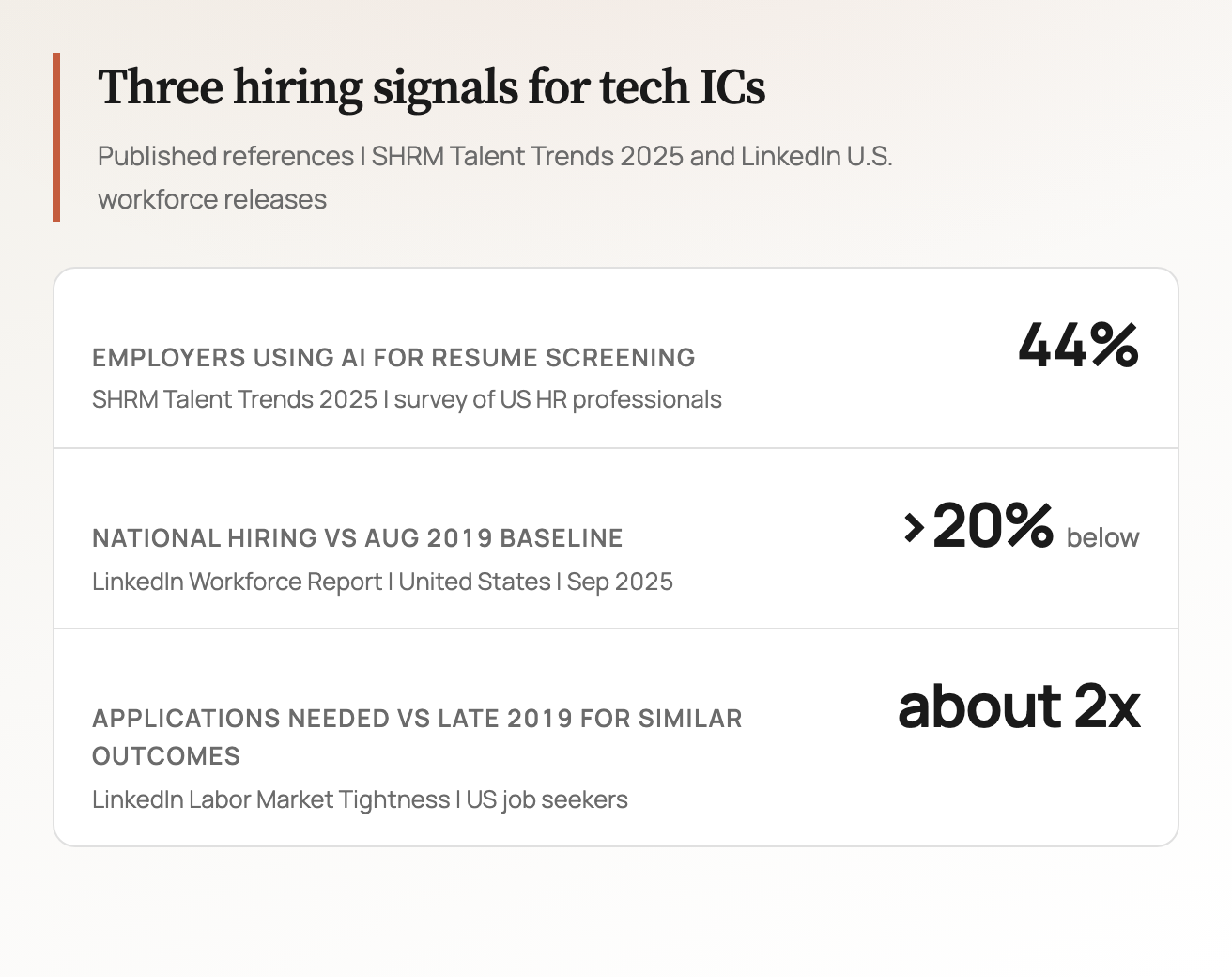
That backdrop is why structured workflows beat generic chat: screening automation and shallow hiring velocity show up before your resume reaches a human, without the observability you'd insist on for production traffic. ai-career-toolkit is built as a practical starting point for using AI to boost targeting, evaluation, resume signal, interviews, and outreach while keeping artifacts local and reproducible. Your agent keeps repeatable workflows instead of reinventing context each session so your search compounds instead of resetting weekly.
Not another job board
This is not a SaaS product, job board, or ATS connector. It's markdown skills, agent definitions, templates, and a tiny CLI - domain expertise your assistant can load locally. Your data stays on disk; there's no signup server.
The toolkit is MIT licensed and
public on GitHub.
It bundles Agent Skills, sub-agents, privacy rules, and reusable templates -
see the repo for what ships today.
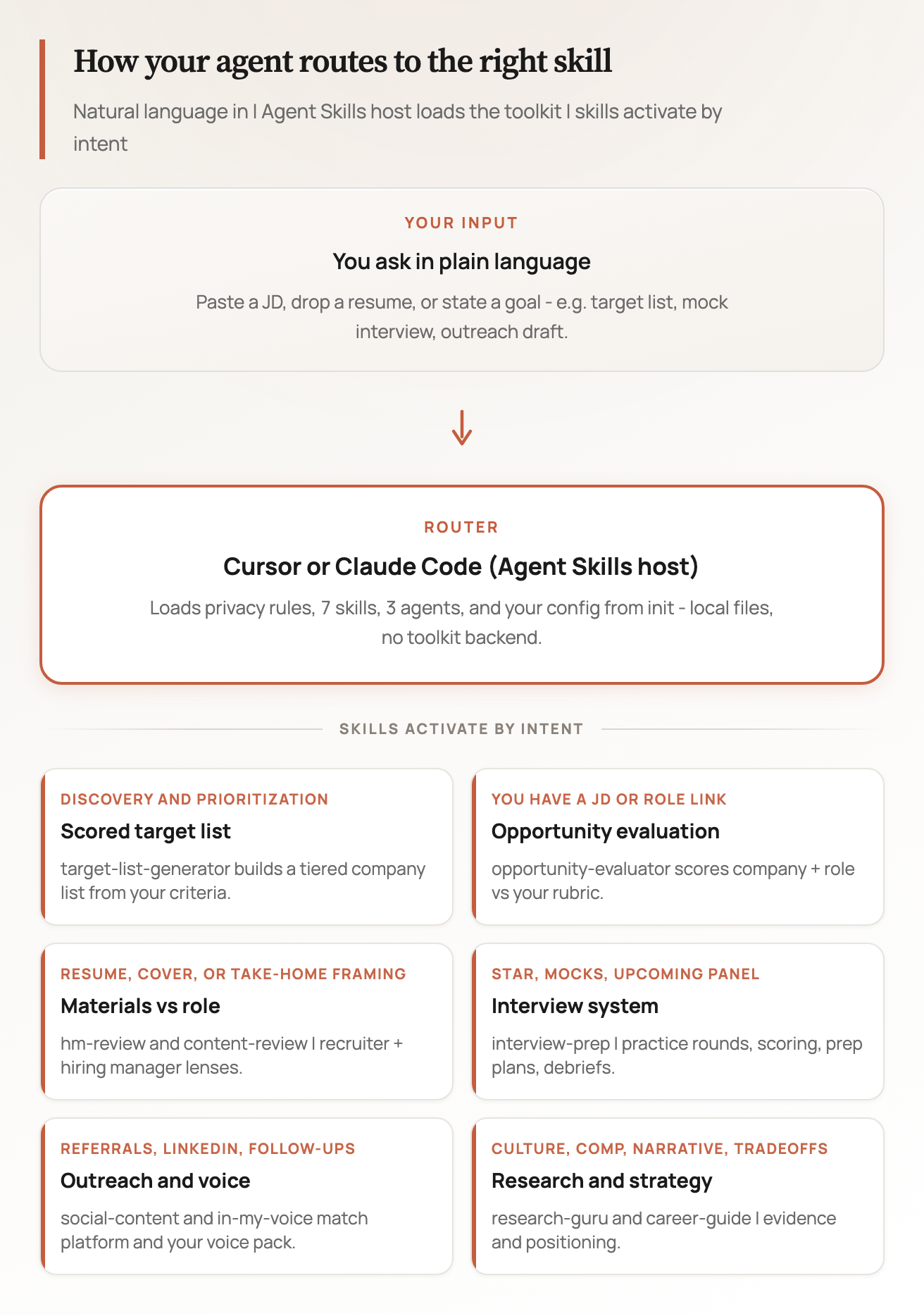
One command (ai-career-toolkit init) sets
everything up. After that, you talk to your AI agent in natural
language and the right skill activates automatically.
What it actually does
The toolkit is organized around the jobs you actually need to do during a search - not around its own internal architecture. Here's the walkthrough:
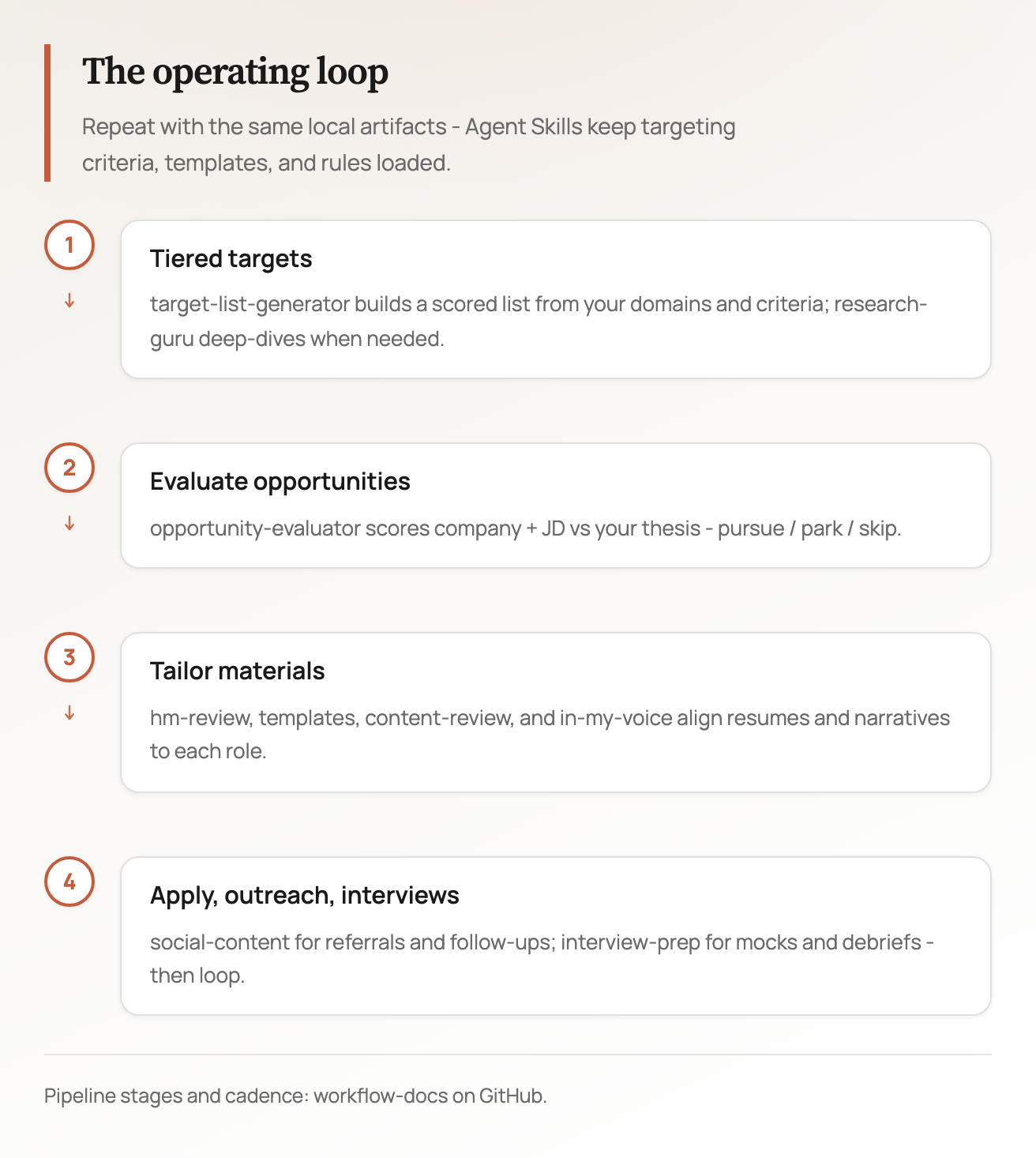
ai-career-toolkit init - repeat weekly with the same local artifacts.
Quick Start and CLI flags:
README Quick Start.
Prompt catalog:
Playbook.
Pipeline methodology:
company list pipeline and
workflow-docs.
Skills in depth
Each capability activates from plain-language prompts in Cursor or Claude Code. Expand a section for what it does and a starter prompt.
Finding companies worth targeting
The target-list-generator skill builds a scored, tiered list of companies from your configured domains, stage preferences, and role criteria. It's not a generic "top 50 tech companies" list - it uses your specific targeting to research companies that match. The research-guru agent handles the deep dives: engineering culture signals, compensation benchmarks, leadership stability, hiring activity, and red flags, all with source citations.
Build me a target company list for AI infrastructure and developer tools - Staff Engineer roles, remote-first.
Evaluating opportunities
The opportunity-evaluator skill takes a job description (paste the full text), researches the company, and scores the opportunity against your personal role thesis. It returns a structured pursue / park / skip recommendation with explicit reasoning. This replaces the gut-feel "should I apply?" decision with a repeatable framework.
Evaluate this opportunity at [Company] - here's the JD: [paste the full job description]
Resume and application review
The hm-review skill reviews your resume through two lenses simultaneously: a recruiter screen (clarity, keywords, scanability, level alignment) and a hiring manager depth check (impact evidence, ownership signal, technical credibility). It returns a verdict, prioritized fixes, and a tightened rewrite.
Interview preparation
The interview-prep skill handles the full cycle: building STAR stories from rough notes, running mock interview rounds with scored feedback and concrete critique, creating structured prep plans for upcoming panels, and debriefing after interviews to capture lessons. It's one skill with multiple modes, not a fragmented set of tools.
Prep me for a systems design interview at [Company] - mock questions, STAR stories, the works.
Writing and outreach
Three skills cover the writing surface. social-content drafts LinkedIn posts, recruiter outreach, referral requests, and follow-ups with platform-aware tone. in-my-voice rewrites anything to match your personal voice using a local voice pack (you build it once from writing samples, then every output sounds like you). content-review does structured editorial passes on professional and technical content with audience-adaptive depth.
Career strategy
The career-guide agent handles the strategic layer: role positioning, offer tradeoffs, career narrative shaping. It gives you a recommendation, explicit tradeoffs, risks, and concrete next actions. It delegates to the other agents and skills as needed - research-guru for evidence, wordsmith-editor for rewrites.
How it works under the hood
Each skill is a SKILL.md file that follows the
Agent Skills specification.
It defines when the skill should activate, what workflow it follows,
and what output format it produces. Sub-agents are markdown
definitions with explicit scope boundaries and handoff rules - they
know what they handle and what to delegate. Privacy-oriented rules ship
by default - including guidance to keep PII out of git-tracked files and to hold outputs to a sensible quality bar for content.
The interesting part - and the part that connects to the
context engineering
work I've written about before - is that the skills encode real
domain expertise. The hm-review skill knows what a
recruiter screens for versus what a hiring manager evaluates. The
interview-prep skill knows how to structure a STAR
story with metric anchors and follow-up depth points. The
opportunity-evaluator knows which signals matter in
company research and how to weight them against personal criteria.
This is what turns a generic AI chat into a structured, repeatable system. The agent isn't improvising - it's operating within a designed information architecture that produces consistent, high-quality output.
Getting started
Install paths, prerequisites, CLI flags, and troubleshooting change in the repo over time - use the README as the single source of truth instead of duplicating steps here.
-
README.md
- Quick Start, install (including pipx),
ai-career-toolkit init, and when things break. - docs/GETTING_STARTED.md - Deeper setup: voice pack, story bank, personalization.
- Playbook - Paste-ready prompts for each job-to-be-done.
After init, open your agent in Cursor or Claude Code and start from the Playbook or the example prompts above.
Personalize it for you
Skills ship generic; outcomes improve when you load your facts into the paths init sets up: toolkit config under the repo and ~/.ai-career-toolkit/ for private career notes that stay off the public tree.
-
Baseline from init
- Role, level, domains, must-haves; use
ai-career-toolkit init --personalizewhen your targets shift mid-search. -
Role thesis
- Finish
~/.ai-career-toolkit/role-thesis.md: value proposition, nice-to-haves, quick-screen filters soopportunity-evaluator,hm-review, and targeting stay aligned with how you actually decide. -
Voice pack
- Replace placeholders under
config/voice-pack/with real samples soin-my-voicematches how you write. - Stories and rubric - Map experience into the story templates and optional role-expectation rubric so interview prep has substance to rehearse against.
Walkthroughs and checklists: docs/GETTING_STARTED.md and docs/customization-guide.md.
What's next
ai-career-toolkit is for tech professionals running an active search or pivot - engineers, PMs and program managers, EMs and directors, IC or leadership, early-career through senior.
Want to contribute? Use CONTRIBUTING.md as the living guide so expectations stay current as workflows evolve.